Title: Moving Beyond Assertions: The Shift from Test Verification to AI Observation
SEO Slug: ai-browser-agents-exploratory-testing
Meta Title: AI Browser Agents vs Traditional Test Automation
Meta Description: Traditional E2E testing validates known paths but misses unexpected regressions. Discover how hybrid QA strategies leverage AI agents for continuous observation.
Short Summary: Traditional automated test suites are excellent at verifying known inputs and outputs, but they fail to catch the unexpected visual and UX regressions that disrupt real users. By introducing AI browser agents into the QA pipeline, engineering teams can shift from rigid, scripted verification to continuous, open-ended observation—creating a hybrid testing strategy that combines deterministic safety with automated exploratory insight.
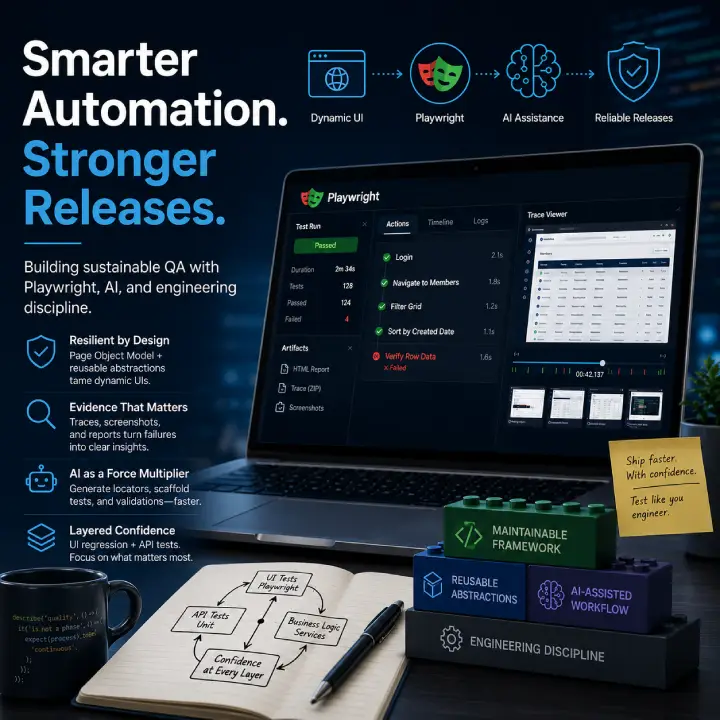
Most engineering teams have a love-hate relationship with their end-to-end test suites. We spend months writing requirements, building features, and carefully crafting automated scripts in Playwright or Cypress to validate known workflows. We celebrate when the build goes green. Yet, almost every production incident reveals the same frustrating truth: the bugs that bite users are rarely the ones our assertions were looking for.
Traditional QA automation excels at deterministic verification. It is incredibly effective at checking if a login button works, if a checkout form submits, or if API responses match a strict schema. But these tests are inherently limited by our own foresight. They test exactly what we expect them to test, following a rigid path from point A to point B.
If a UI update subtly breaks page navigation, causes content to render invisibly below the fold, or introduces an awkward UX regression that derails a user journey, a scripted test will often pass right by it. The logic holds, but the experience is broken. Historically, catching these edge cases required human eyes; someone manually clicking through pages, exploring the application, and acting like an actual user. This boundary is exactly where the engineering friction lives, and it is where AI browser agents are quietly shifting the paradigm.
From Execution to Observation
The shift isn’t happening because AI is inherently smarter than a well-written automation script. It is happening because AI agents change the core directive from execution to observation.
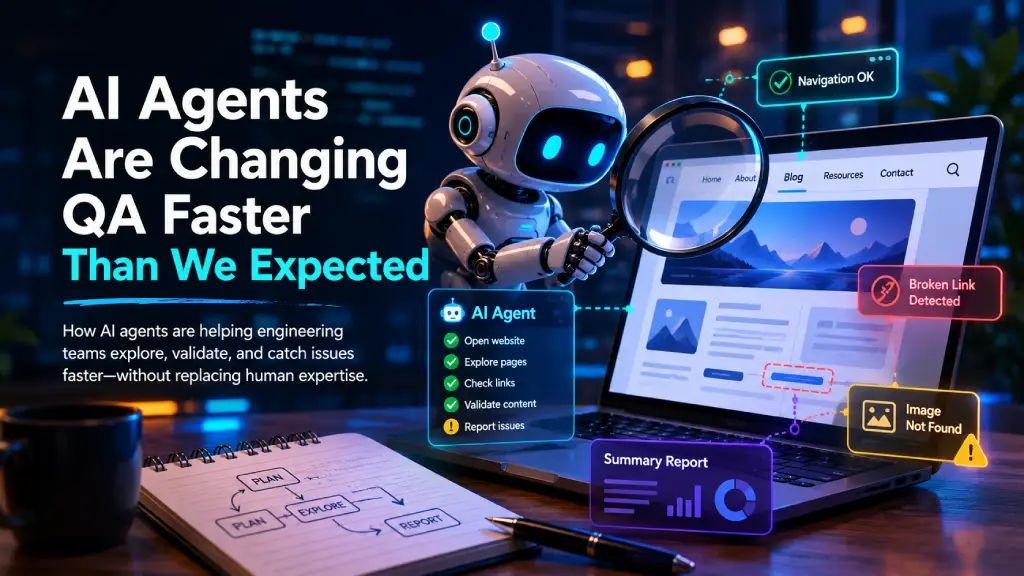
When we write traditional automation, we instruct the machine to execute a precise sequence of actions: click here, wait for this selector, assert that text. If anything deviates—even a minor, harmless CSS change—the script breaks. Conversely, a browser-based AI agent operates on higher-level objectives. Instead of executing a single pre-determined script, we can give it an objective: explore the documentation site, click through the main navigation paths, and flag anything that looks visually broken or incomplete.
| Testing Paradigm | Process Flow | Ultimate Output |
| Traditional Automation (Verification) | Input Script -> Strict Execution Path | Pass/Fail Assertion |
| AI Agent Testing (Observation) | High-Level Objective -> Dynamic Contextual Navigation | Insight/Anomaly Report |
The agent isn't simply replaying recorded clicks. It perceives the document object model (DOM) and the visual layout dynamically, adapting its journey based on what it encounters. It fills a massive operational gap that sits directly between rigid, deterministic scripts and time-consuming manual review.
This introduces a subtle but critical distinction in engineering philosophy: validation versus observation. Scripted automation validates known state transitions. AI agents observe behavioral anomalies.
Implementing an Automated Exploratory Layer
By deploying an agent to crawl a staging environment, an engineering team gains a lightweight, automated exploratory layer. The agent can follow internal links, inspect rendering consistency across diverse page types, and generate summarized logs of unusual behavior. It doesn't replace the need for an assertion that a credit card transaction processes successfully, but it does drastically accelerate the sanity checks and smoke testing that eat up valuable sprint cycles.
The most practical applications of this technology today are intentionally unglamorous. Teams are finding success using AI agents for open-ended website reviews, post-deployment sanity checks, and first-pass acceptance criteria validation. It acts as a force multiplier. If an agent can flag that a footer layout collapses on mobile viewports across half of your marketing pages before a human QA engineer ever opens the preview link, the feedback loop shrinks from hours to minutes.
The Interpretation Bottleneck
However, the industry narrative that AI will entirely replace QA professionals misunderstands how software is actually delivered. AI agents are fundamentally missing domain context. They don’t understand business intent, they cannot weigh the strategic trade-offs of a cutting-edge feature, and they lack the nuanced product empathy that an experienced QA engineer brings to the table.
When observation becomes cheap and automated, the bottleneck shifts entirely to interpretation. AI agents will surface more anomalies, more edge cases, and more visual variations. Sorting that noise from genuine regression requires deep organizational context and human judgment.
The immediate future of testing isn't fully autonomous; it is hybrid. The strongest engineering orgs will deploy a dual-engine QA strategy. Deterministic scripts will continue to safeguard the core business logic and critical data paths. Concurrently, AI-driven exploratory layers will continuously map, observe, and report on the cracks that form between those scripts. We aren't automating human judgment away; we are finally giving it the clean data and focused time it needs to matter.