Most engineering teams don't actually have a testing problem. They have a maintenance problem. We’ve all seen the cycle: a suite of automated tests is built with high ambitions, only to be ignored three months later because the selectors are brittle, the environment is dynamic, and the effort to fix a red build outweighs the perceived value of the test itself.
In a recent project for a complex, member-focused platform, we hit this wall early. The application relied heavily on dynamic Kendo UI grids and intricate role-based permissions. A single UI refinement could ripple through the navigation logic for four different user types. Manual regression was no longer a viable safety net; it was a bottleneck that was starting to dictate our release cadence.
The goal wasn't just to automate the pain away. It was to build a sustainable architecture that treated QA code with the same rigor as production code, while leveraging AI to handle the repetitive scaffolding that usually makes automation feel like a chore.
The Friction of Dynamic State
The real difficulty in modern web automation isn't clicking a button; it's knowing when that button is actually ready to be clicked. Our platform’s heavy use of asynchronous loading and grid-based interfaces meant that traditional Selenium-style sleep statements were a recipe for flakiness.
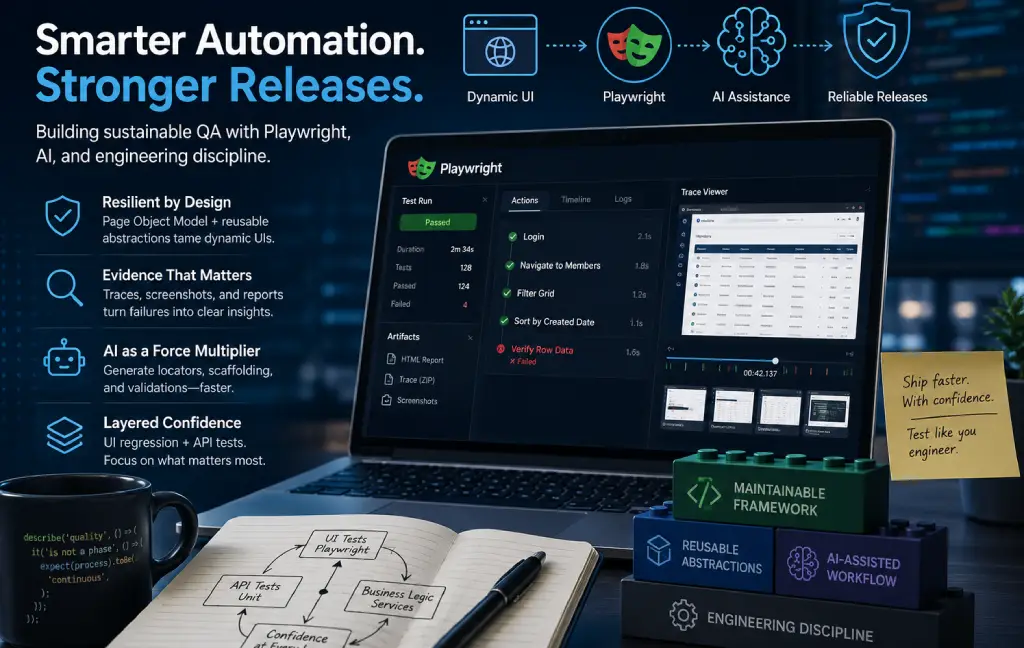
We chose Playwright specifically because it treats the web as it actually exists today: asynchronous and unpredictable. Playwright’s auto-waiting logic and web-first assertions meant we stopped writing code that guessed when the DOM was ready. But the tool is only half the battle. To handle role-sensitive behavior, we had to move away from flat test scripts and toward a robust Page Object Model (POM) that abstracted the complexity of the Kendo UI components.
By creating reusable abstractions for the grids—logic that handled filtering, sorting, and reset behaviors—we ensured that if the underlying UI library updated, we had one place to fix the logic, rather than fifty broken test files.
Engineering the Evidence Trail
One of the most overlooked aspects of QA is what happens when a test fails. A console log saying Error: Element not found is useless at 4:00 PM on a Friday. We structured our framework to generate a forensic record for every execution.
Each run produces a timestamped artifact folder containing HTML reports, screenshots, and interactive traces. The Playwright trace tool, in particular, changed our debugging culture. Instead of trying to reproduce a failure locally, developers can open a trace file and see exactly what the browser was doing at the millisecond of failure. This shifted the conversation from "the test is flaky" to "here is the specific race condition in the API response."
The AI-Assisted Workflow
We made a conscious decision to use AI not as an autopilot for testing, but as a specialized pair programmer. AI is remarkably good at looking at a snippet of HTML and generating a Playwright locator or scaffolding a repetitive test suite for a new user role.
By feeding our established page abstractions and UI screenshots into our development workflow, we were able to generate the boring parts of the automation—the field-level validations and basic navigation flows—in minutes. This allowed the engineers to focus on the high-level strategy: defining the edge cases for permission-based access and ensuring the state management between tests remained clean.
This wasn't about replacing the engineer; it was about removing the activation energy required to keep the test suite growing. When it’s easy to add a test, tests actually get added.
Shifting the Perspective
The most significant outcome of this approach wasn't the percentage of coverage; it was the shift in confidence. By separating UI regression (Playwright) from backend business logic (API unit tests), we created a layered defense. We didn't try to automate every single click on day one. We started where the risk lived: login, password resets, and the core data grids.
Sustainable QA isn't a destination; it’s a commitment to building a framework that is easier to maintain than it is to ignore. By combining modern browser automation with AI-driven productivity, we didn't just build a safety net; we built a foundation that allows the team to ship faster, knowing that the most critical paths are being watched by a system that is as dynamic as the code it tests.
The future of QA isn't in larger test suites. It’s in smarter, more resilient architectures that turn testing back into engineering.