On paper, system upgrades are linear. You bump a version string in a configuration file, run the migration tool provided by the vendor, pull down the updated dependencies, and resolve whatever breaking changes the compiler throws at you. It looks like a predictable afternoon task.
In production environments with deep histories, that linear path disappears within five minutes. A single framework bump cascades into a mess of conflicting package versions, broken references, and ambient build failures in modules that no one has touched in three quarters. The issue usually isn't the core framework itself. The issue is the accumulated weight around it; old lock files, environmental configurations hidden in local development setups, or transitive dependencies pulling down incompatible binaries from a registry.
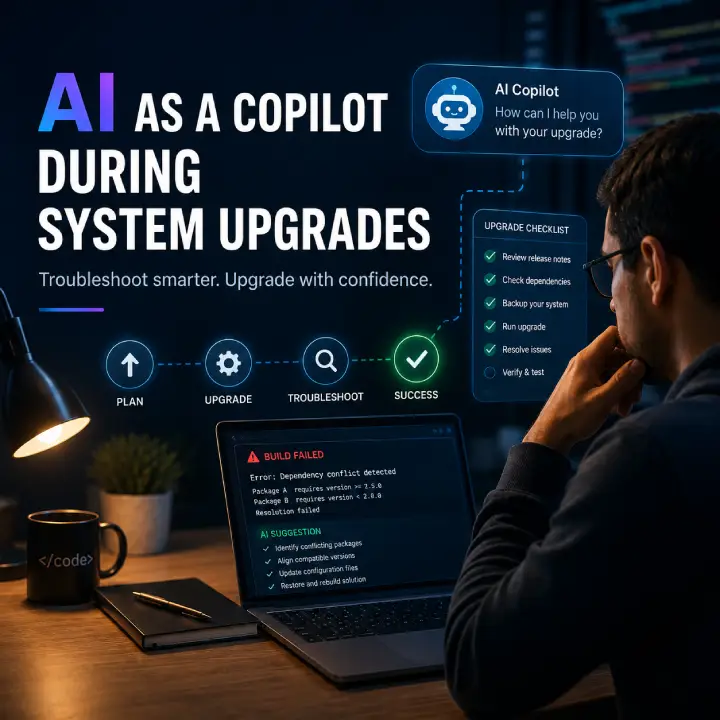
When a multi-project solution fails to build after an upgrade, the immediate environment becomes incredibly noisy. A developer is often left staring at hundreds of lines of compiler output where the primary root cause is buried under secondary symlink errors or package restoration warnings. This is where engineering momentum stalls. The process quickly turns into a reactive loop of clearing caches, running random install commands, and hoping the build error count decreases on the next execution.
Deconstructing the Noise with Targeted Analysis
Using an LLM as an autocomplete engine during a broken upgrade frequently compounds the frustration. Code generation models excel when boundaries are tight, but they struggle when dropped blindly into a failing, highly coupled system. The real utility of AI during a migration lies upstream from code generation. It belongs in the diagnostic phase.
When a build log spits out a wall of text detailing a dependency resolution failure, the immediate need is parsing, not patching. Instead of guessing at the dependency tree, isolating the full error block and asking a model to map out the explicit version conflict isolates the signal from the noise.
"Analyze this package restoration failure log. Map out the explicit dependency path causing the mismatch. Identify which package is forcing the older version constraint and determine if this is a direct reference or a transitive dependency chain."
This approach treats the model as a specialized interpreter. It changes the workflow from guessing which package to upgrade next to knowing exactly which sub-dependency is pinning the system to an older runtime. The engineer still makes the architectural choice on how to resolve the conflict, but the time spent translating a noisy stack trace into a concrete diagnostic is reduced significantly.
Moving from Guesswork to Structured Troubleshooting
The value of an analytical partner becomes apparent right before you write a line of code or modify a configuration file. When a migration stalls, the natural human temptation is to start changing files immediately to see if something hits. That reactive pattern is how project files get corrupted, and repository states diverge from standard baselines.
Before attempting a fix, utilizing an AI assistant to construct a localized checklist keeps the troubleshooting process disciplined. This means asking the model to evaluate the architectural layout of the project files and suggest specific, low-risk diagnostic steps based on the symptoms.
Writing Explicit Boundaries for Coding Agents
If the decision is made to delegate parts of the remediation to an automated coding agent or a workspace tool, the instructions must be highly restricted. Vague prompts like "fix the build errors in this solution" give an agent too much latitude. The agent will often attempt to refactor perfectly valid code, update unrelated packages, or introduce modern syntax choices that run counter to the project's style guidelines.
Effective execution requires strict containment parameters. The prompt must define the problem space, the allowable toolset, and the explicit constraints of the task.
Review the solution files for broken package references caused by the recent framework migration. Target Scope: - Inspect package configuration files and direct project references. - Audit lock files for version constraints that contradict the target version. Constraints: - Do not modify application source code or rewrite business logic. - Do not upgrade unrelated packages or introduce new third-party dependencies. - Maintain the existing package management architecture. Goal: Bring the system back to a clean compilation state using only targeted configuration fixes.
By establishing these guardrails, the developer remains the architect of the upgrade. The AI handles the mechanical work of updating references across dozens of project files, but it does so within a strictly defined sandbox.
The Indispensable Role of Engineering Judgment
An AI model cannot weigh risk. It operates on patterns, not contextual awareness of an organization's technical debt or deployment constraints. During a complex upgrade, the model might suggest a solution that is technically elegant but practically disastrous for a production system.
Consider a scenario where an upgrade exposes a breaking change in an open-source database driver. The model may correctly suggest rewriting the data access layer to comply with the new API. While technically accurate, that suggestion ignores key engineering variables:
- The testing coverage over that legacy data layer might be sparse.
- The team might be two weeks away from a major release cycle.
- The business risk of introducing a subtle runtime error in production outweighs the benefit of having the absolute latest driver package right now.
An experienced engineer might choose to isolate the legacy driver using an abstraction layer, stick to an older but compatible version for the time being, or patch the local build environment to accept the deprecation warning. These decisions require contextual judgment, risk tolerance assessment, and an understanding of human team dynamics; qualities that do not exist in a matrix of weights and tokens.
Reducing the Cognitive Burden of Maintenance
The value of integrating AI into system migrations isn't about raw speed or automated magic. It is about preserving cognitive energy.
Debugging dependency hell and resolving version mismatches is mentally draining work. It requires holding complex tree structures in your head while fighting with cryptic tooling outputs. By offloading the parsing, sorting, and cross-referencing of error logs to an analytical partner, engineers can keep their minds focused on what actually matters: evaluating tradeoffs, managing architectural integrity, and making informed decisions about risk.
The build will eventually compile. The migration will eventually finish. By using AI as a deliberate diagnostic tool rather than an autopilot, the resulting codebase remains clean, predictable, and fully understood by the people who have to maintain it tomorrow.