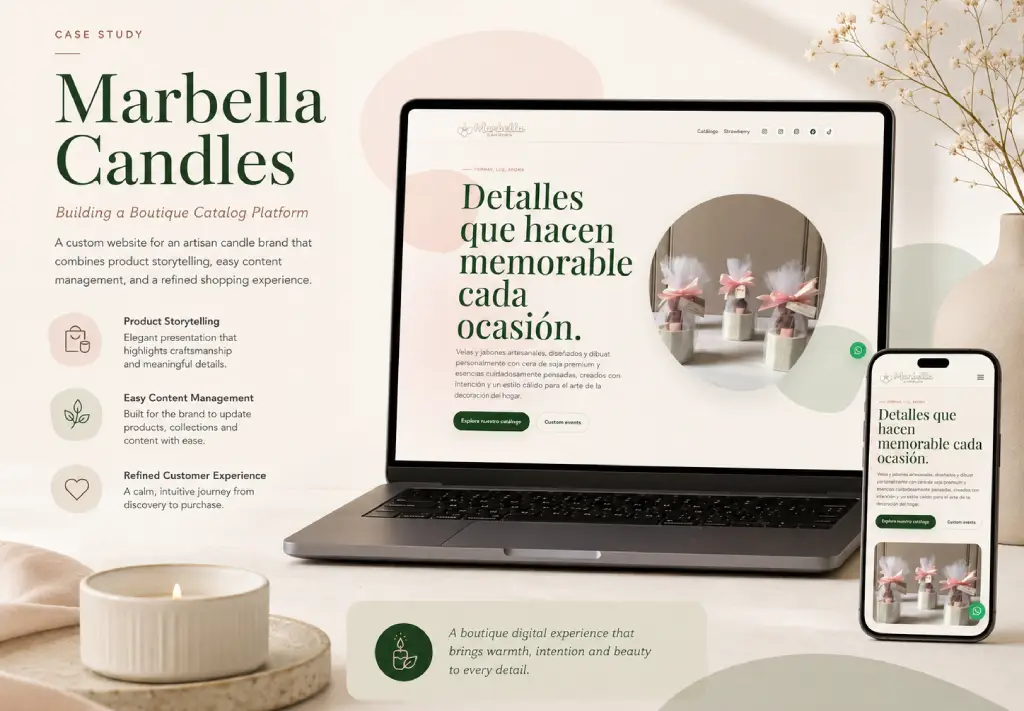
Marbella Candles started with a simple but meaningful challenge: how do you give a small artisan brand a digital presence that feels polished, trustworthy, and easy to manage without forcing it into the complexity of a full e-commerce platform? The brand did not need a heavy storefront with carts, checkout flows, inventory rules, and marketplace-style features. It needed something more intentional: a beautiful product catalog, a place to tell its story, a way to keep content fresh, and a direct path for customers to start a conversation.
That became the foundation for Marbella Candles, a custom catalog and content platform built around the way a small handmade brand actually sells. Instead of treating every product as a checkout transaction, the site was designed to support discovery, curiosity, and contact. Customers can browse candles and soaps, explore product details, view scents, occasions, images, notes, and related products, then continue the conversation through WhatsApp. This approach keeps the buying experience personal, which is especially important for artisan products where presentation, gifting, customization, and trust often matter as much as the product itself.
From the beginning, the goal was not to build “just another website.” The goal was to create a brand platform. Marbella Candles needed a public experience that felt calm, warm, and boutique, but it also needed an admin experience that allowed the business owner to manage products, pages, images, homepage sections, brand settings, and catalog content without touching code. That balance shaped the entire architecture. The public site presents a polished storefront, while the admin area works as a lightweight custom CMS tailored specifically to the business.
The public catalog is intentionally simple and visual. Products are displayed through a browsable grid with categories, scent and occasion context, pricing, likes, sharing options, and links to detailed product pages. The catalog avoids the noise that can come with generic e-commerce templates. Instead of overwhelming the visitor with transactional UI, it focuses on product discovery. Each product detail page acts as its own shareable sales page, combining gallery images, product descriptions, profile details, scent information, occasion tags, notes, related products, and a clear WhatsApp call to action. This gives every product a stronger presence and makes it easier for customers to share or revisit specific items.
The content side of the platform is just as important as the catalog. Marbella Candles is not only selling products; it is building a brand. For that reason, the project includes dynamic content pages that can be used for brand storytelling, care instructions, seasonal messaging, collection pages, informational content, or future editorial material. These pages support rich text, hero images, thumbnails, galleries, tags, related products, draft states, and navigation placement. That means the site can grow as the brand grows, without requiring a developer every time a new story, guide, or campaign needs to be published.
One of the most valuable parts of the project is the admin area. For a small business, a custom website only remains useful if the owner can actually maintain it. The admin experience was designed around business concepts rather than technical abstractions. Products can be created, edited, activated or deactivated, priced, categorized, tagged, connected to scents and occasions, enriched with notes, paired with related products, and supported with galleries. Pages can be drafted, published, edited with rich text, connected to images, and placed in navigation areas. Homepage sections are also database-driven, allowing the landing page to evolve seasonally through reusable layouts such as hero sections, featured products, galleries, testimonials, FAQs, and calls to action.
This modular homepage system is one of the project’s strongest decisions. Many small-business websites begin as static pages and slowly become difficult to maintain because every new campaign or content change requires editing markup. Marbella Candles takes a different route. Homepage sections are modeled as editable content blocks that map to Razor partials, giving the site structure without making it rigid. The result is a homepage that can tell different stories over time while still preserving a consistent visual identity.
The solution is organized into clear layers for web, services, and data, keeping controllers focused while moving business behavior into dedicated services. The data model includes products, categories, scents, occasions, tags, product galleries, product notes, related products, dynamic pages, page galleries, homepage sections, media assets, brand settings, catalog settings, and admin users. This structure keeps the system focused on the real needs of the brand instead of trying to mimic a generic CMS or a full online store.
The media pipeline was another important engineering decision. Product photography is central to a boutique catalog, but unmanaged image uploads can quickly damage performance. Marbella Candles handles uploaded media by validating files, resizing images, converting them to WebP, storing them as media assets, and serving them through controlled media routes with long-lived cache headers and ETags. This keeps the site fast and consistent while giving the owner a simple way to manage visuals. It is the kind of behind-the-scenes feature that users may never notice directly, but they feel the result when pages load quickly and product images remain polished.
SEO was treated as a first-class requirement, not an afterthought. The site includes friendly slugs, dynamic metadata, canonical URLs, Open Graph tags, Twitter card support, sitemap generation, robots.txt handling, structured data, and noindex behavior for draft or private content. Product pages, collection pages, and content pages are designed to be discoverable and shareable. For a small brand, this matters because every product and every story has the potential to become an entry point from search engines, social platforms, or direct sharing.
The project also makes a practical distinction between what is ready for the public and what is still being prepared. Products can be active or inactive. Pages can be drafted, disabled, previewed, and protected from indexing when they should not appear publicly. This publishing model gives the owner room to prepare content safely, review it, and publish only when it is ready. That small detail makes the platform feel much more mature than a static catalog.
What makes Marbella Candles interesting as a case study is not only the technology used, but the judgment behind what was intentionally left out. A full checkout system would have added complexity, maintenance, payment concerns, cart logic, order management, stock tracking, and support obligations. For this brand, that was not the right first step. A WhatsApp-first catalog better matches the sales flow of a handmade business where customers may want to ask questions, confirm availability, personalize an order, or discuss delivery before buying. The platform solves the current business problem without overbuilding beyond it.
The visual direction supports that same philosophy. The site uses a soft boutique identity with warm backgrounds, botanical tones, elegant typography, rounded imagery, and calm spacing. It avoids the cold feeling of many generic product grids and instead gives the brand room to feel handcrafted. The experience is designed to feel approachable, personal, and premium without becoming overly complicated. On mobile, the layout adapts through responsive grids, navigation behavior, and spacing adjustments, keeping the catalog usable where many customers are most likely to browse.
From a business perspective, Marbella Candles now has more than a website. It has a maintainable platform for presenting products, shaping brand perception, publishing content, improving search visibility, and guiding customers toward direct contact. The owner can update the catalog, refresh homepage sections, publish new pages, change brand information, manage images, and keep the site aligned with seasonal campaigns or product launches. That independence is one of the biggest wins of the project.
From an engineering perspective, the project demonstrates how a custom solution can be more valuable than a generic platform when the scope is well understood. The architecture is simple enough to maintain, but flexible enough to grow. The CMS features are specific to the business instead of being overloaded with unnecessary abstractions. The SEO layer supports long-term discovery. The media pipeline protects performance. The admin tools reduce dependency on developers. Together, these decisions create a practical foundation that can evolve into richer features later, such as product availability, analytics, newsletter capture, advanced filtering, or even optional checkout if the business eventually needs it.
Marbella Candles is a strong example of building software at the right size. It does not try to be Shopify. It does not try to be a generic CMS. It focuses on what the business needs today: a beautiful catalog, editable content, optimized images, SEO-ready pages, and a direct path from interest to conversation. That focus is what makes the project feel cohesive. Every technical decision supports the product experience, and every product decision respects the reality of a small artisan brand.
In the end, this project is about more than candles, soaps, or catalog pages. It is about giving a small business a digital home that feels like its brand, works with its sales process, and can grow without becoming fragile. Marbella Candles shows how thoughtful engineering can turn a simple product catalog into a polished, maintainable, and business-friendly platform.