The most expensive phase of an enterprise software integration rarely happens in the IDE. It happens weeks earlier, buried inside a collection of mismatched CSV exports, undocumented JSON structures, and legacy database schemas.
We recently faced the task of evaluating a migration between two disparate membership-management platforms. On paper, the goal was straightforward: determine whether the export payload from a new vendor could natively support our existing data pipeline. In reality, the two systems were built on entirely conflicting philosophies. Our system was heavily relational, deeply dependent on explicit parent-child hierarchies, spouse mapping, household groupings, and years of accumulated lifecycle metadata. The incoming dataset was flat, event-driven, and structured around an entirely different domain focus.
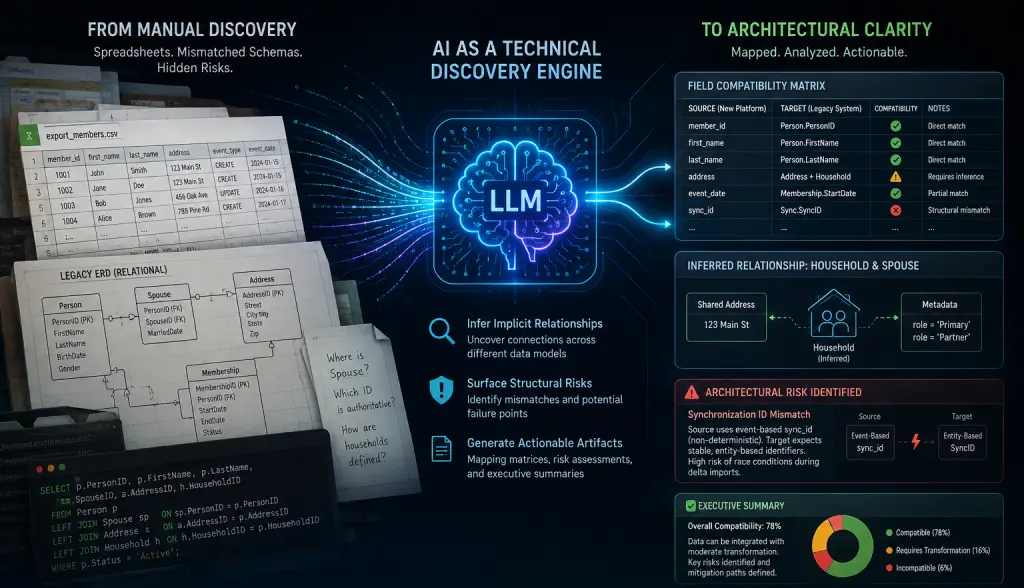
Traditionally, resolving this mismatch requires a grueling period of manual data archaeology. You spend days opening massive spreadsheets, tracing entity-relationship diagrams, running investigative SQL queries, and translating your findings into a matrix of field mappings. It is tedious, high-friction work that drains an engineering team’s cognitive energy before a single line of code is written.
Instead of taking the traditional route, we treated a large language model not as a code generator, but as an architectural discovery engine. By feeding the LLM our target schema definitions, production database constraints, and sample export structures, we transformed a passive data-review process into an active, conversational analysis session.
Uncovering Implicit Relationships
The immediate benefit wasn't just the automated mapping of obvious fields like string matching or date formats. The real leverage appeared in the model’s ability to infer implicit relationships across disparate data hierarchies.
For instance, while the new platform lacked explicit spouse records, the AI flagged a pattern of shared unique addresses and metadata markers that allowed us to deterministically reconstruct household entities. Concurrently, it surfaced an architectural risk we had overlooked: a structural mismatch in how synchronization IDs were handled that would have silently caused race conditions during delta imports.
Inverting the Discovery Timeline
This approach flips the traditional development timeline. Instead of spending 80% of our discovery phase compiling data profiles and 20% analyzing them, the ratios inverted. The repetitive cognitive overhead of cataloging data fields was completely offloaded, allowing us to focus entirely on technical judgment—evaluating which data gaps were fatal to the business logic, which missing attributes could be safely ignored, and how the existing system's performance boundaries would react to the payload structure.
Crucially, documentation ceased to be a lagging indicator of the work completed. Because the discovery was driven through structured analysis prompts, the resulting artifacts—field compatibility matrices, edge-case risk assessments, and executive technical summaries—were generated as a direct byproduct of the engineering process itself.
The Acquisition of Context
The industry remains heavily focused on AI as an automated coding assistant. Yet, the deep systemic friction in modern software engineering is rarely the typing of syntax; it is the acquisition of context. Legacy systems are opaque, integrations are messy, and documentation is universally flawed.
Before a team can execute, they must first understand the ground truth of the data they are inheriting. Using AI as an interpretation layer bridges this gap, enabling engineers to spend less time auditing spreadsheets and more time engineering systems.