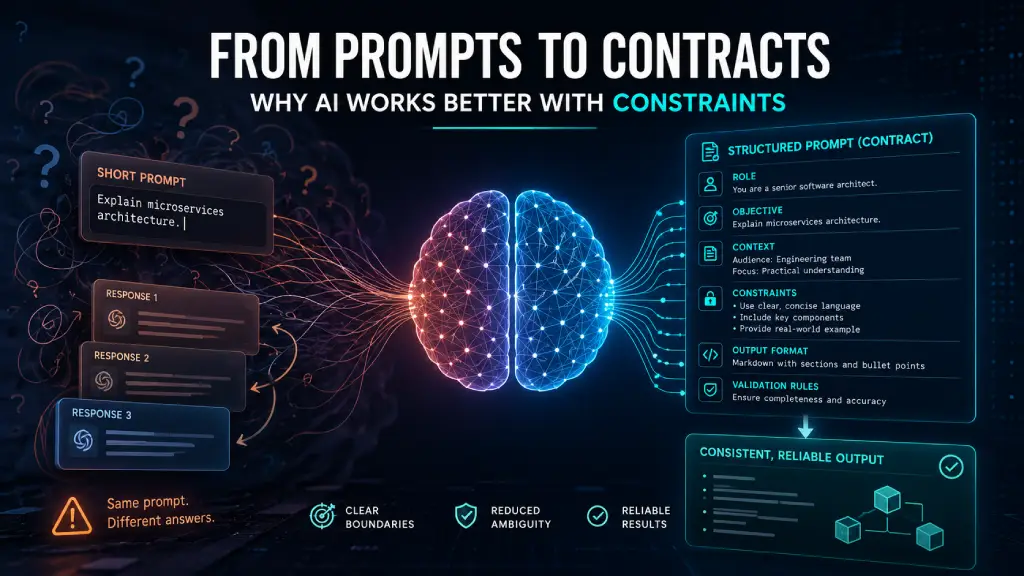
One of the most common assumptions about AI is that it performs best when given freedom. Ask a short question. Keep the prompt simple. Let the model think.
To be fair, this approach often works. Short prompts can produce surprisingly good results. Sometimes they generate creative ideas, concise explanations, or even useful code faster than expected. That experience has helped shape a popular belief that prompt engineering is mostly about finding clever wording and avoiding unnecessary detail.
But after spending significant time building AI-assisted engineering workflows, I have found myself reaching a different conclusion. The real challenge is not getting a good answer. It is getting good answers consistently.
That distinction matters more than it first appears. In professional workflows—software development, architecture reviews, technical audits, or implementation planning—variability becomes a problem long before intelligence does. And that is where constraints start to matter.
Short Prompts Are Not the Problem
There is nothing inherently wrong with short prompts. In fact, they can be incredibly effective. Ask an AI to summarize an article, explain a concept, or brainstorm ideas, and a lightweight prompt is often all that is needed.
The issue is not quality. The issue is reliability.
Ask the same AI the same open-ended question twice and you may receive two different answers. Neither answer may be wrong; sometimes both are useful. But they can differ in structure, assumptions, depth, priorities, or reasoning.
That behavior is not a bug; it is part of how these systems work. For casual usage, that flexibility is often desirable. For engineering workflows, however, variability creates friction. If AI is helping define architecture, generate implementation plans, evaluate risks, or produce structured deliverables, the standard changes entirely. We stop asking if the isolated answer is good, and start asking if the underlying process can be trusted to behave consistently.
The Problem with Probabilistic Systems
Part of the confusion comes from how people mentally model AI. Many unconsciously treat it like a compiler or a deterministic tool: provide input, receive output, repeat identically.
Language models do not operate that way. They are probabilistic systems. The same request can follow different reasoning paths, prioritize different details, or produce different styles of response depending on how ambiguity is interpreted.
Unconstrained (Probabilistic Drift):
[ Open-ended Prompt ] ──► ( Interprets Ambiguity )
──┬──► [ Style A / Assumption X ]
├──► [ Style B / Assumption Y ]
└──► [ Style C / Assumption Z ]
Constrained (Deterministic Alignment):
[ Prompt + Contract ] ──► [ Enforced Boundaries ] ────► [ Consistent, Repeatable Output ]
That flexibility is one of AI's strengths, but it is also one of its biggest operational challenges. Probabilistic systems naturally create variation, and variation becomes difficult to manage when the output feeds into repeatable technical workflows. This is where many teams encounter frustration. The AI appears remarkably capable, but its behavior feels inconsistent. The core issue is almost never intelligence; it is ambiguity.
Stabilizing Behavior Through Structure
This is the point where conventional wisdom gets things backward. Constraints are sometimes viewed as limitations—too many instructions, too much structure, too much guidance. The assumption is that more freedom allows the model to perform better. In practice, the opposite happens.
Constraints reduce ambiguity, and reducing ambiguity improves stability. Clear boundaries help define:
- Format & Scope: Expected output schema, terminology definitions, and strict boundaries of analysis.
- Execution & Order: The precise order of reasoning priorities and execution steps.
- Validation Rules: Acceptable assumptions and hard rules regarding what must be flagged or ignored.
The result is not necessarily a more creative AI, but a more dependable one. That difference matters because most engineering work does not fail from a lack of creativity. It fails from misunderstanding, inconsistency, or unclear expectations. AI is no exception.
Moving from Prompts to Systems
One of the more interesting realizations is that prompts eventually evolve into something else. They stop behaving like simple instructions and start behaving more like systems.
This usually happens gradually. A team adds formatting rules. Then expected outputs. Then scope boundaries. Then reusable instructions and validation logic. Eventually, the prompt transforms into a repeatable process, a lightweight framework, and a reusable contract.
This transition changes the core relationship. Instead of asking isolated questions, teams begin designing structured interactions. The goal shifts from asking the system to help with a specific task to commanding the system to follow a defined process and produce a specific class of outcome.
This changes everything because the conversation becomes less about prompt optimization and more about engineering systemic behavior.
From Creativity to Reliability
There is an understandable fascination with AI creativity, and creativity certainly has value. But real-world engineering workflows demand reliability. A code review framework should behave predictably. An implementation plan should follow an expected structure. An audit workflow should apply consistent reasoning.
In these environments, the objective is not maximum variation; it is controlled variation inside defined boundaries. That is why structured prompts, reusable rules, and explicit expectations become increasingly important as AI moves deeper into production systems. It is not because the technology is failing, but because the standards for dependable systems are significantly higher than the standards for interesting conversations.
AI does not always improve when given fewer instructions. In an engineering context, it improves when given clearer boundaries. Freedom creates variety, but constraints create reliability. As these tools become embedded in professional workflows, the future will not belong to the shortest prompt. It will belong to the clearest contract.