Title: The Interpretation Layer: Moving Beyond Chatbots in Clinical Data Systems SEO Slug: ai-interpretation-layer-clinical-data-biomarkers Meta Title: AI as an Interpretation Layer for Complex Medical Data Meta Description: Moving beyond generative AI to build specialized interpretation layers. Learn how we structured clinical biomarker data to accelerate cardiometabolic analysis. Short Summary: While generative AI dominates public discourse, the deepest technical impact lies in creating specialized interpretation layers for unstructured data. Facing a mountain of static, siloed medical laboratory reports, we built a system that combines automated data normalization with deterministic clinical indexes, transforming raw biomarkers into a structured, longitudinal cardiometabolic profile.
Most business systems collect enormous amounts of data, but very few truly understand what that data actually means. In the current landscape, the conversation around AI is almost entirely dominated by generative models, tools that can draft an email, compose a landscape, or mimic human banter. While these applications are undeniably impressive, they represent the most visible, and perhaps most superficial, layer of the technology. The most profound impact often happens away from the spotlight, tucked deep within specialized systems where it handles the heavy lifting of data interpretation in fields like medicine.
Modern healthcare generates a staggering volume of information, yet much of that data remains trapped in static formats. It is underutilized not for lack of value, but because the cognitive load required to synthesize it is so high. In a typical clinical setting, a single laboratory report can contain dozens of biomarkers, ranging from glucose and lipid fractions to inflammatory markers and liver enzymes.
For a physician, these numbers are pieces of a high-stakes puzzle. However, for most digital health systems, these values are merely isolated entries in a database. They are stored and displayed, but they aren't truly understood. This gap between data storage and data interpretation represents one of the most significant opportunities for engineering solutions that provide real-world utility rather than just conversational novelty.
The Operational Hurdle of Unstructured State
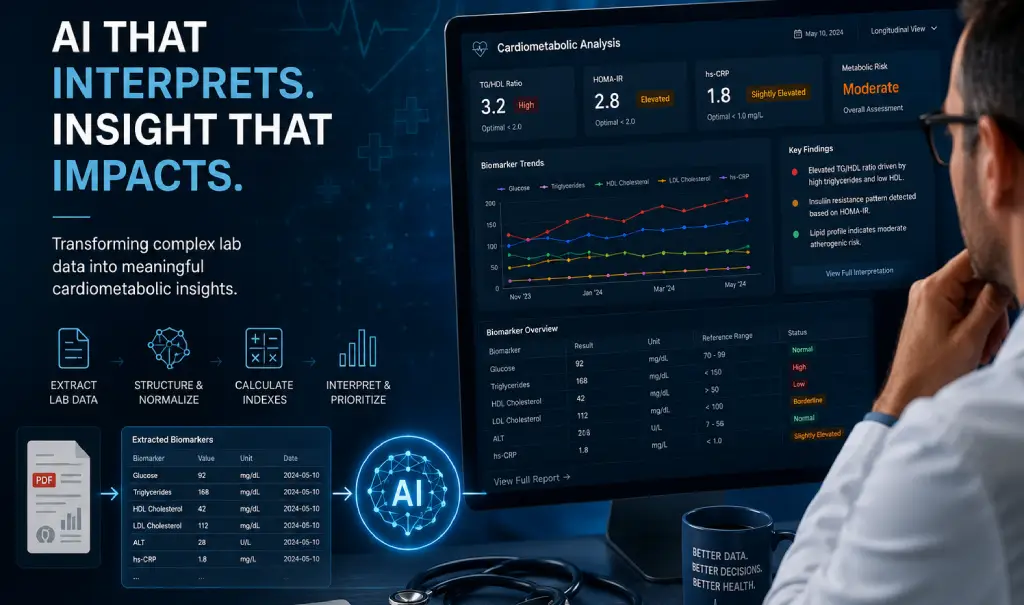
Recently, I focused on a project designed to bridge this gap by using AI to assist in cardiometabolic analysis. The challenge wasn't just about moving numbers from a page to a screen; it was about creating a system capable of transforming fragmented laboratory reports into a structured health profile.
This began with the operational hurdle of data extraction. Most lab results are delivered as PDFs or scanned images, unstructured formats that traditionally require manual entry, a process rife with friction and human error. By implementing an AI layer to identify biomarkers, detect dates, and normalize disparate units, we transitioned from a manual bottleneck to an automated, assisted workflow.
Blending Deterministic Logic with Pattern Recognition
Extraction, however, is merely the foundation. The real engineering complexity lies in the interpretation. Once the data is structured, it can be passed through established cardiometabolic indexes, such as triglyceride-to-HDL ratios or insulin resistance estimators.
While the calculations for these indexes are deterministic, and must remain so for clinical accuracy, AI excels at providing the interpretive layer. It can identify subtle patterns across longitudinal data, surface the most critical findings, and contextualize how these markers relate to one another according to the latest medical literature.
This implementation highlights a critical distinction in responsible development: the difference between using a model to generate information out of whole cloth and using it to interpret structured, scientific data. By constraining the AI to analyze known biomarkers within the framework of established medical science, we create a tool that amplifies human expertise rather than attempting to replace it. It reduces the cognitive burden on the practitioner, allowing them to reach a more informed judgment faster, without sacrificing the precision of deterministic science.
The Architecture of Collaboration
The success of this approach suggests a broader architectural pattern applicable to finance, law, and engineering alike. By combining structured data with deep domain knowledge and clear logic rules, AI serves as the essential bridge between raw information and actionable insight.
We are moving toward a future where the value of these systems is measured not by how well they talk, but by how effectively they collaborate. When we stop viewing AI as a chatbot and start seeing it as a sophisticated interpretation layer, we unlock its potential to have a tangible impact on specialized fields—and on human health itself.