Most software teams know how to recognize obvious technical problems. A slow API gets immediate attention. A security vulnerability becomes an urgent patch. A production outage creates immediate pressure. These are visible, loud problems; they interrupt the business, trigger alarms, and demand action.
But there is another category of software problem that rarely shows up in logs or dashboards. It does not break production, it does not trigger PagerDuty alerts, and it doesn't cause a dip in your conversion rate. And yet, over time, it becomes one of the most expensive problems a system can have.
That problem is cognitive friction.
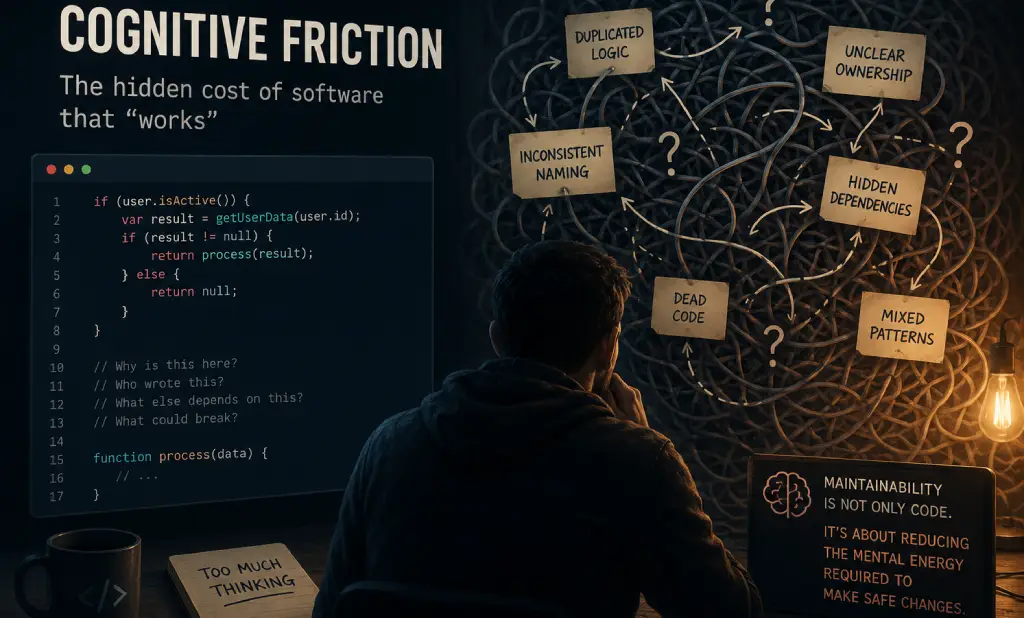
Cognitive friction is the invisible resistance developers feel when making changes. It’s the hesitation before opening a specific file, the uncertainty around whether a small fix will trigger a cascade of side effects, and the extra hour spent decoding a naming convention that should have been obvious. Unlike performance bottlenecks or runtime failures, cognitive friction is experienced by humans.
Because humans are the ones maintaining the system, their mental overhead is a direct line item on the company’s balance sheet. A system can be stable for years and still become increasingly expensive to evolve; not because the business logic is wrong, but because the path to changing it has become a labyrinth.
Where the Friction Hides
The most interesting thing about cognitive friction is that it often hides inside successful systems. These aren't bad products; they are often mature, revenue-generating platforms. From the outside, everything looks healthy. But internally, every feature request feels heavier than it should.
A simple change takes days instead of hours because no one remembers where a specific business rule actually lives. A bug fix requires touching five unrelated files because logic was duplicated over three years of shifting requirements.
This is where cognitive friction differs from traditional technical debt. Technical debt is often structural and visible: outdated dependencies, missing tests, or known architectural shortcuts. Cognitive friction, however, is experiential.
Consider naming. In a high-friction system, customer-related logic might appear under CustomerService, ClientManager, AccountHandler, and ProfileProcessor. Nothing is technically broken. The compiler doesn't care. But every developer now spends extra mental energy answering basic questions: Which one owns what? Which one should I modify? Are they interchangeable?
Multiply that across hundreds of files and thousands of pull requests, and the cost becomes significant.
Architectural Eras and Fragmented Mental Models
This friction often stems from inconsistent abstractions. A project may begin with direct data access, then move to repositories, then later introduce a mediator pattern. Over time, these architectural eras coexist. The result isn't necessarily bad architecture, but a fragmented mental model.
A developer cannot rely on one consistent way of understanding the system; they have to perform historical archaeology every time they open a new module.
One reason this survives so long is that traditional audits miss it. A security audit finds vulnerabilities; a linter finds syntax errors; a code quality tool finds cyclomatic complexity. But cognitive friction sits in the gaps between these metrics. A function might pass every linting rule and still be mentally exhausting to modify because of implicit dependencies or clever logic that defies intuition.
Evaluating Code Through the Lens of Change
Maintainability cannot be reduced to syntax. It must be evaluated through the lens of change, focusing on three core operational questions:
- Context: How much context does a developer need to load into their head before they can safely act?
- Safety: How many invisible, undocumented rules must be remembered to avoid a regression?
- Utility: Is the code actively helping the developer understand the system, or is it getting in the way?
When understanding a system depends more on institutional memory than code clarity, the system becomes fragile. This isn't just a technical risk; it’s an organizational one. If a key developer leaves and the "why" behind the code goes with them, the business cost of every future feature in that domain doubles overnight.
The Economic Reality of Version Seven
Reducing cognitive friction is not about reaching some academic ideal of clean code. It is about reducing unnecessary thinking. Good systems still require deep thought, but that thought should be directed at solving the business problem, not deciphering the implementation.
The real cost of software is rarely in building version one. The real cost is in version seven, years later, after three teams have touched it and the original vision has blurred. If a system resists change, it isn't failing technically, but it is failing economically. In the world of software, where change is the only constant, a high-friction codebase is a liability that no amount of working code can offset.