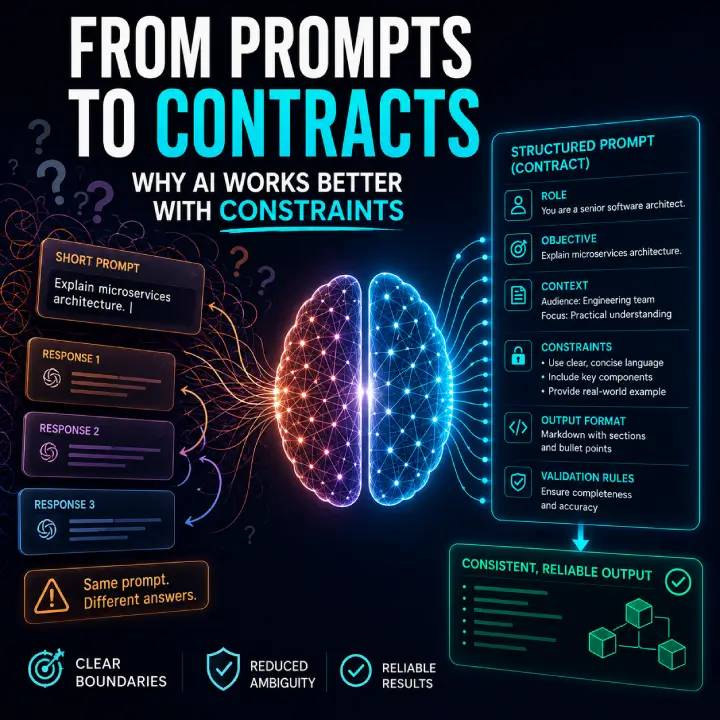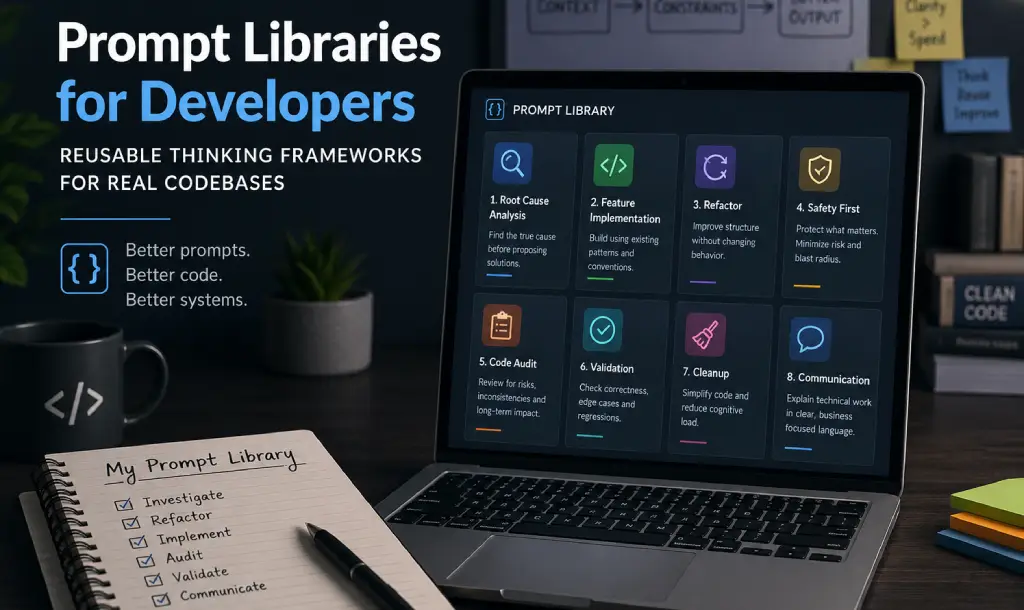
Most conversations about prompt engineering focus on getting better outputs from AI. Better wording. Better formatting. Better results. For developers, that framing is incomplete. The real value of prompt engineering is not in learning how to ask better questions. It is in learning how to encode repeatable engineering judgment into reusable instructions.
In real software work, we rarely solve entirely new problems. We solve familiar categories of problems over and over again: a bug investigation, a risky refactor, a new feature that must fit an existing architecture, a code review, or a technical summary for stakeholders. The specifics change, but the patterns remain. Once you recognize that, your prompts stop being ad-hoc requests and start becoming a library. Not a library of code, but a library of thinking.
A common mistake in AI-assisted development is treating prompts like casual instructions. "Add validation," "Fix this bug," or "Refactor this component" are technically valid but operationally weak. They lack constraints, intent, and quality boundaries. A better implementation prompt behaves like a lightweight specification. It defines what success looks like, what should remain unchanged, and how the solution should align with the existing system.
Consider a refactor prompt. It should not simply ask for cleaner code. It should define the conditions under which the refactor is acceptable:
Refactor this component following existing project patterns. Do not introduce new abstractions unless necessary. Preserve current behavior and API contracts. Optimize for maintainability and readability.
This changes the dynamic entirely. The AI is no longer inventing in open space; it is operating inside engineering boundaries. And boundaries are what make software maintainable.
One of the most useful prompt patterns I’ve refined is for issue investigation. Many developers make the mistake of prompting for a fix before understanding the failure. That is backwards. Good debugging begins with understanding system behaviour, not changing it. That principle can be encoded directly:
Analyze this issue and identify where the behaviour originates. Trace the execution flow before proposing changes. Find the root cause, not just the visible symptom. Recommend the smallest safe fix.
This prompt enforces discipline. It forces investigation before implementation, mirroring how experienced developers already work. The goal is not speed; the goal is correct speed.
This logic extends to feature implementation. Generating new code is easy. Generating code that belongs inside an existing codebase is much harder. A good feature prompt reminds the AI that the system already has patterns, utilities, and conventions. Its job is to integrate, not reinvent. Without this constraint, you run into architectural drift. This is the hidden cost of AI-generated code where the output works, but it slowly stops belonging to the rest of your system. That drift is expensive to clean up later.
We must also realize that code generation is only one-use case. Evaluation is often more valuable. When reviewing a module, I rarely want suggestions first; I want evidence of structural weaknesses or long-term maintenance risks. This requires a different kind of posture:
Review this module for maintainability and hidden risks. Identify structural inconsistencies and operational friction. Provide evidence-based findings only. Prioritize issues by long-term engineering impact.
This transforms the AI into an analysis layer rather than a code writer. In many systems, identifying problems earlier is more impactful than generating more code. It moves the needle from pushing out more features to preserving better architecture.
The more explicit the constraints, the better the output. In engineering, removing reality from a prompt—ignoring dependencies, legacy contracts, or data integrity—produces unrealistic code. Safety prompts that ask "What must survive the change?" shift the focus toward preserving backward compatibility and minimizing the blast radius.
Even when the AI generates good code, validation remains its own engineering activity. It deserves its own phase and its own prompt to check edge cases, error handling, and state consistency before a human review even begins. This is essentially automated pre-review thinking, catching obvious gaps and improving both code quality and review efficiency.
Finally, we have to account for the cleanup. Working code often contains unnecessary complexity like extra branches, duplicate logic, or structural noise. A cleanup prompt helps reduce cognitive load, which is one of the most expensive invisible costs in software. It does not just fix the software; it ensures the software does not slow down every future change.
The biggest shift in AI-assisted development is not faster code generation; it is the ability to externalize engineering judgment. A prompt library is a way to reduce decision fatigue and create consistency across a team. These are not just shortcuts; they are operational frameworks. Code changes, but good decision frameworks scale with every project. Increasingly, they scale with every prompt.